
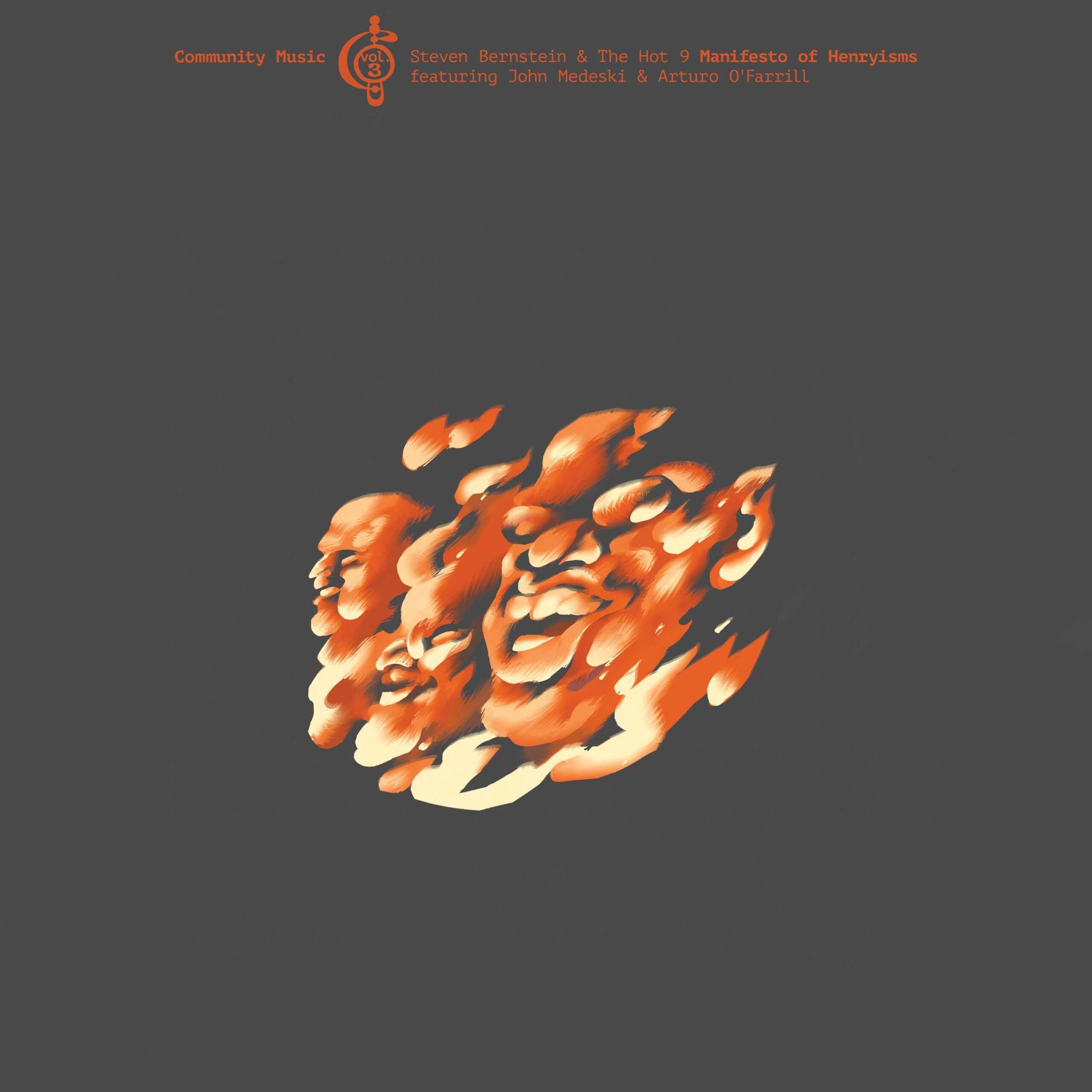
Description
Steven Bernstein first saw the late, great New Orleans pianist Henry Butler play in 1984. “He was genius-level brilliant, man,” he says, still marveling. “I couldn’t believe there was a guy who could sound like the most ancient music and the most futuristic music at the same time.” (Which is an apt description of Bernstein’s music too.) Fourteen years later, Bernstein took Hal Willner’s recommendation and hired Butler to play in the touring band that played the score for Robert Altman’s film Kansas City. In 2013, the two musicians formed the Hot 9, the name a tip of the fedora to Louis Armstrong’s landmark Hot Five and Hot Seven sessions of the 1920s. They released the acclaimed Viper’s Drag album the following year, and toured until Butler’s untimely passing in 2018.
‘Manifesto Of Henry-isms’ is Bernstein’s term for the rhythmic and harmonic idiosyncracies in Butler’s piano playing. For his inventive arrangements, Bernstein isolated those “Henryisms” and distributed them to different musicians in the Hot 9, so now Butler’s style was emulated by an entire ten-piece band, effectively turning his piano into an orchestra. To hear Bernstein’s Henry-istic arrangements in action, listen to Butler’s solo piano version of his James Booker tribute “Booker Time” (from 2002’s ‘Patchwork: A Tribute to James Booker’) and then hear Bernstein’s full-band version, and the way it demonstrates the lineage between Dixieland and funk.
While Butler is no longer here to play the arrangements that Bernstein wrote for him, his spirit remains deep in this music. “I wanted to document these arrangements,” Bernstein says, “while we still had Henry’s feeling in our bodies.” But, without Butler’s resounding musical presence, Bernstein urged the band to go its own way. “We know what he taught us,” he says, “so let’s take that and make it ours. We’re carrying it forward.”
When Butler, Bernstein and the Hot 9 played the 2016 Newport Jazz festival, Butler “commissioned” Bernstein to write an arrangement of “Diminuendo and Crescendo in Blue,” the Duke Ellington tune that set the stage for Paul Gonsalves’ legendary 27-chorus tenor sax solo at the 1958 Newport Jazz Festival, which almost singlehandedly revived Ellington’s career. But here, it’s O’Farrill who takes the epic solo — and all the ensemble parts the band plays during the solo are derived from sections of Gonsalves’ tenor solo.
You can also hear the modern touch in the Hot 9’s take on “Bogalusa Strut”: slowed from Sam Morgan’s original 1927 prestissimo to a saucy vivace, the tune has a levitational free coda that was not part of the Butler-era arrangement. Then there are Bernstein’s trademark newly composed introductions: in “Little Dipper,” which is the introduction to King Oliver’s “Dippermouth Blues,” the melodies cycle around each other in a way that’s more Henry Threadgill than Dixieland. You’ll hear some Machito in “Indigo Aperitif,” Bernstein’s sprightly introduction to “Diminuendo and Crescendo in Blue,” and “X-Men” explodes the Bernstein-composed introduction to “Wolverine Blues” from Viper’s Drag into a full-blown composition.
If you’re looking for the sound of community, look no further than on “Black Bottom Stomp”: there’s a 48-bar collective improvisation, and what could easily be a chaotic free-for-all becomes ten brilliant musicians having a funky conversation, listening, reacting and keeping it grooving in the uncanny way that only a true community can.